//

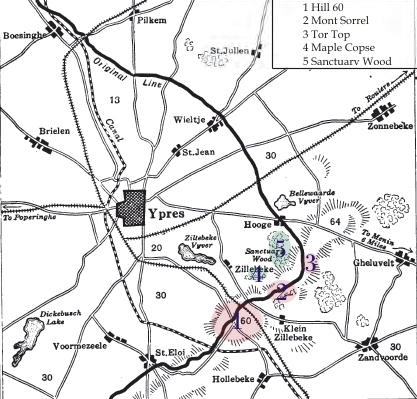
Photo: Halsey, Francis Whiting., Public domain via Wikimedia Commons
A well-preserved World War I battle site that changed sides repeatedly. There area covered in craters. There was also a large amount of tunneling during the war which adds to the uneven terrain. The memorial to the 1st Australian Tunneling Co contains bullet holes from World War II.
The Capture of Hill 60 took place near Hill 60 south of Ypres on the Western Front, during the First World War. Hill 60 had been captured by the German 30th Division on 11 November 1914, during the First Battle of Ypres. Initial French preparations to raid the hill were continued by the British 28th Division, which took over the line in February 1915 and then by the 5th Division. The plan was expanded into an ambitious attempt to capture the hill, despite advice that Hill 60 could not be held unless the nearby Caterpillar ridge was also occupied. It was found that Hill 60 was the only place in the area not waterlogged and a French 3 ft × 2 ft mine gallery was extended.
© OpenStreetMap contributors
Bellewaerde was established in 1954 as a zoo and safari park. The park evolved into a theme park. Bellewaerde attracts 850,000-900,000 visitors a year and is one of the main theme parks in Flanders.
Military cemetery in the town of Ypres with 198 Commonwealth soldiers buried next to the Lille Gate (Rijselpoort).
Menenpoort
Dedicated on 24 July 1927 as a memorial to the missing British and Commonwealth soldiers who fell in Belgium during World War One. Has a Last Post Ceremony each night at 20:00 as a way for the Ypres citizens to express their gratitude towards those who died for Belgium's freedom.
This museum gives an excellent overview of World War I. It is more like an experience that takes you right into daily life during the war. The experience is very moving, and it's a must-see for everyone coming to Ypres, young and old. Allow at least 2 hr for a full museum visit. When the weather is good enough, the belfry tower is also available for visiting for an additional cost, giving you a great overview of the front region.
Museum in a beautiful setting, telling the story of the Great War in chronological order. Lots of information on the different battles and a large selection of authentic artifacts on display. The big bonus of the museum is a reconstructed dug-out which lets you experience what life under Flanders Fields must have been at the time.
The largest Commonwealth War Graves Commission cemetery in the world, situated to the south of the village of Passchendaele. There's a massive wall at the back of the cemetery, containing names of many missing soldiers. The battle of Passchendaele is known for its big loss of human lives, for a minimal gain in worthless territory. There are also many more smaller Commonwealth cemeteries dotted around the region as well.