//

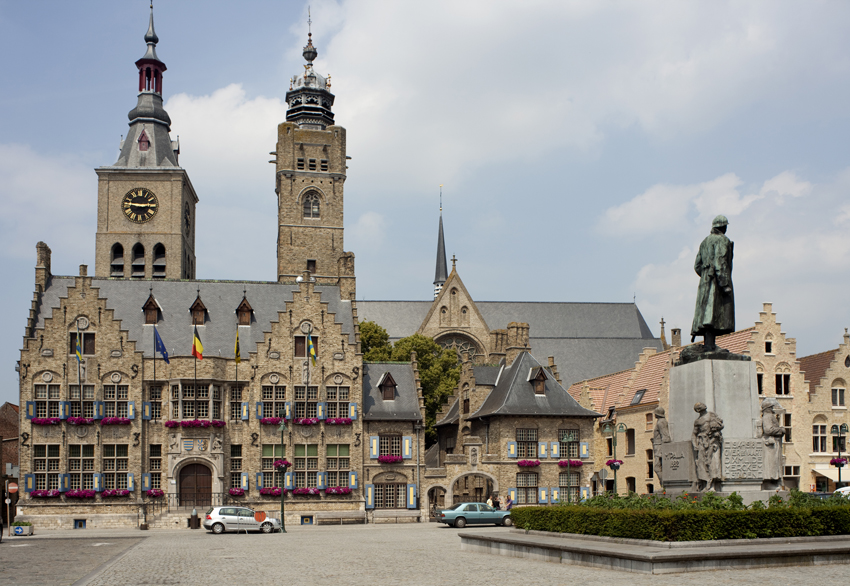
City and municipality in Flemish Community, Belgium
Photo: PMRMaeyaert, CC BY-SA 3.0 via Wikimedia Commons
Diksmuide is in West Flanders. Diksmuide is known as the Butter City, referring to the flourishing dairy trade that was one of the city's most important pillars of prosperity for centuries. However, the city is best known for the First World War, and its historical sites from the Yser Front.
From the travel guide. Select a place for details, a map and what is nearby.
This cemetery is one of the four remaining German cemeteries. Unlike the British cemeteries, all German victims were gathered into four big cemeteries. There are many more soldiers buried than the number of grave stones would give away. The cemetery in Vladslo also shows the artwork The grieving parents, by Käthe Kollwitz.
Dodengang
This memorial site is a reconstruction of the trenches found near the Yser. At this place, the enemy lines were just a few metres apart (as opposed to the more northern region, where there was a big floodplain). Many people died in these trenches, due to the many raids from both sides.
The Yser Tower is the tallest peace memorial in Europe. The first Yser tower was built after World War I, to honour the Flemish soldiers who fell at the river Yser. The tower had a big meaning for those who wanted Flemish independence. After World War II, the first tower was dynamited, as a payback for the many Flemish who collaborated with the Germans. The remains of the first tower are still visible on top the Pax gate (the entrance gate to the site). After World War II, the tower was rebuilt, and now remembers both wars. The top of the tower contains the initials AVV-VVK, written in a cross. This stands for "All For Flanders, Flanders For Christ", symbolising the meaning of the tower for the Flemish. The four sides of the tower show the sentence "No more war" in the languages of the four fighting sides: Dutch, English, French and German. You can visit the tower, inside it, there's a museum about both world wars, and about the call for Flemish independence and the relation with the wars. At the top of the tower, you get a nice panoramic view over the very flat region.
Belgian families were allowed to choose, whether they wanted their son to be buried on the battlefield, or at their home. Many people chose the grave near their home, resulting in the rather low amount of Belgian graves. This is the biggest remaining Belgian cemetery.
Stadhuis
The foundation stone was laid in 1428. Major renovations were carried out between 1567 and 1572. A painting by Hacke from 1716 also shows an inner courtyard and a small chapel tower. The construction of the third Neo-Gothic town hall took place between 1875 and 1880 according to plans by the Bruges architect Louis Delacenserie, but during the reconstruction (1923) after the First World War, the architects reverted to architectural elements derived from the regional Flemish Renaissance style. The new belfry tower rose in the courtyard as a typically Flemish and medieval symbol of urban freedom.
Sint-Niklaaskerk
This Gothic church lies behind the town hall. It was destroyed in the First World War but subsequently rebuilt according to a plan of the 14th-century Early Gothic version. The original form was also restored to the 18th-century spire. The church also sustained damage during the Second World War.
The main sights in the centre are within walking distance of each other; only the Trench of Death and the Yser Tower are slightly further away.
Read in the guideChoose an airport to see hotels, stations, taxi ranks and car rental desks around it.
Oostende · International · OST
Loading places around the airport…
Articles and travel topics about Diksmuide and Belgium.
 Culture & history
The Belfries of Belgium and France are a world heritage site. The site comprises 56 belfries from Flanders and Wallonia in Belgium, and from far northern France.
Wikivoyage
 Travel tips
Belgium has one of the densest rail networks anywhere in the world. You can expect to travel Belgium by rail to be reasonably timely, fast and frequent, making rail travel in Belgium a convenient way to travel around…
Wikivoyage
 Itineraries
Stretching from Knokke to Adinkerke, the Kusttram (Dutch for "Coast Tram") makes it possible to travel almost the entire length of the Belgian coast by tram.
Wikivoyage
 Travel tips
So you've read all the stories about Antwerp being the diamond capital of the world and are wondering whether it really is cheaper to buy a diamond ring straight from the source rather than pay for all the…
Wikivoyage
Every section of the guide. Open one to read it in full.