//

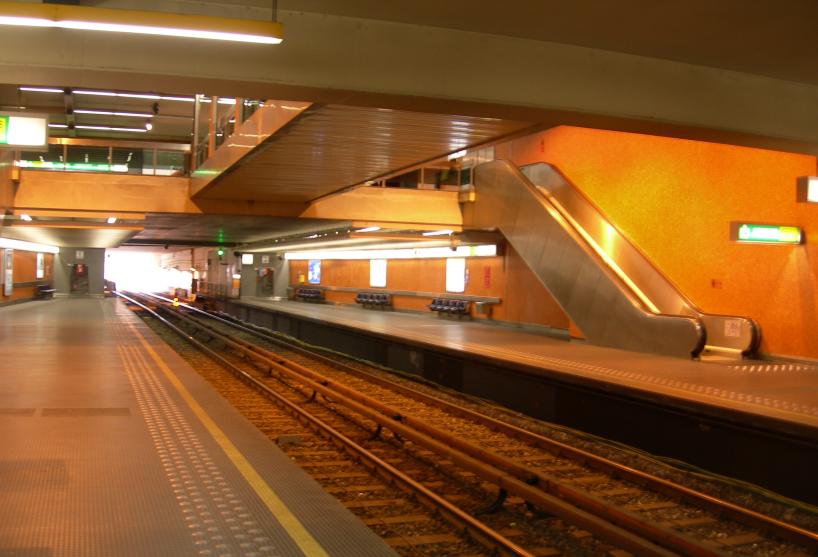
Photo: bsubway.net, CC BY-SA 3.0 via Wikimedia Commons
Metro station opened in 1976 and named after Belgian World War I air ace Edmond Thieffry. It has several interesting sculptures of modern art on display.
Thieffry is a Brussels Metro station on the eastern branch of line 5. It is located in the municipality of Etterbeek, in the eastern part of Brussels, Belgium. It is named after the Belgian aviator Edmond Thieffry.
© OpenStreetMap contributors
Maison Cauchie
Residence designed and built in 1905 by Art Nouveau architect, painter and designer Paul Cauchie, with a facade remarkable for its allegorical sgraffiti. Cauchie picked up this technique from Jean Portaels and Constant Montald when he studied at the Royal Academy for Fine Arts after obtaining his degree in architecture in Antwerp. Aside from his own house, only 3 other houses designed by Cauchie are known, 2 of them also in Brussels. Cauchie was more of a decorator than an actual architect, and specialized in designing sgraffiti for architecture. Cauchie designed his house with the intention of advertising and selling his own work, and the art of his wife. The house was easily seen from neighboring roads, and thus drew attention from passers-by and demonstrated the know-how and skills of the Cauchies. The center of the facade is marked with the words "Par Nous — Pour Nous" (By Us — For Us), illustrating this purpose. After completion, the Cauchies filled their new home with numerous works of art, paintings, wall coverings, furniture, and so on. It is therefore a good example of total art in architecture. The building was almost demolished in 1971, but saved at the last minute and classified as a monument in 1975. It was renovated between 1981 and 1988, and opened as a museum since 1995. The basement of the house contains the cellars where Paul Cauchies workshop has been converted into a gallery exhibition with photos, paintings and archive documents meticulously collected over the years to illustrate the artistic life of Paul and his wife. The upper floors have been converted into private flats and adapted to modern needs, and cannot be visited.
Palais Stoclet
Several turn-of-the-century houses and manors can still be seen today, such as the Stoclet Palace, a , which was built between 1905 and 1909 on a design by Josef Hoffmann and contains mosaics and paintings by Gustav Klimt.
A museum that is dedicated to the art of binding books, with one of the most prestigious bookbinding collections in the world. A quite interesting discovery of a forgotten discipline. Amazing use of materials, that unexpectedly gives room to innovation.
Museum dedicated to the history of 20th century art deco ceramic clocks, which were found in nearly every Belgian and north French household in the early 20th as ceramic was considered the "plastic" of the time. With a collection spanning over 3 floors, the museum has ceramic clocks from French and Czech origin on the 1st floor, Belgian clocks on the 2nd floor, and art deco clocks of German, Dutch, Austrian and Italian origin on the 3rd floor. One of the rooms is entirely dedicated to clocks from the 1950s until contemporary clocks. The ground floor cloak room has several antique clocks from before the 1920s on display as well. The museum is also housed in an art deco building itself, designed by architect Gustave Bussuyt. The museum opens every Sunday at 14:55, and given the nature of the subject, visitors should assume that this time will be respected! Tours are only given in French.
Three escape room games close to the university campus.
Open for visitors.