//

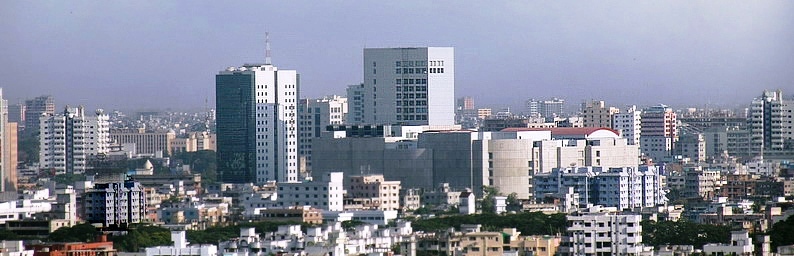
Capital and largest city of Bangladesh
Photo: Tanweer drmc, Public domain via Wikimedia Commons
Dhaka (Bengali: ঢাকা Ḍhākā), formerly Dacca, is the capital and largest city of Bangladesh. It is the largest city by population in the historical region of Bengal and a major city in South Asia. It is a hub for trade and culture, with a long history as a Bengali capital. It has been called the City of Mosques and the Venice of the East, due to its Islamic architecture and a riverfront facing the Buriganga (Old Ganges). It is also known as the Rickshaw Capital of the World, as there are over 500,000 cycle rickshaws running on its roads. Although it is described as a concrete jungle, Dhaka has venerable green spaces, including many gardens and parks.
The world's largest parliament complex, the country's financial heart, most prestigious universities, museums, theaters, art galleries and cultural centers, as well as the city's largest parks, bazaars and markets.
The affluent Gulshan diplomatic zone, the city's cricket stadium, zoo and botanical garden, prominent restaurants, five star hotels, boutique shops and a golf course.
Home to 2,000 buildings from the Mughal and British periods (often in ruins) amid modern structures, and includes historic mosques, tombs, a fort, temples, churches, mansions and libraries; boasts its own imperial cuisine and has a busy river port. Old Dhaka is frentic, colourful and chaotic with narrow alleyways like Hindu Street, the centre of the jewellery trade; and former foreign merchant localities like Farashganj (French village) and Armanitola (Armenian quarter).
Site of the international airport, satellite towns and industrial areas
By train
The first commercial railway service in Bangladesh m began on 15 November 1862 on its first run between Darshana railway station to Jagati railway station.
By bus
Buses are a popular mode of cross country transport in Bangladesh.
By car
Dhaka is the focal point of the national highway system in Bangladesh.
By boat
Most ferries arrive and leave from the port of Sadarghat. This area and its surrounding streets are unbelievably crowded, so allow plenty of time and keep an eye on your valuables.
By rickshaw
Due to poor infrastructure and nasty traffic conditions, one of the quickest ways to get around the city is by rickshaw.
By metro
The planned 6-line has finished construction. The MRT Line 6 was inaugurated in Dec 2022, and the other lines by 2030. One can travel now from Uttara to Motijheel.
By car
It is not recommended for tourists or foreigners to drive in Dhaka. The road network in Dhaka as a whole is severely disorganised.
By auto-rickshaw
Auto-rickshaws, locally known as 'CNGs' (named after compressed natural gas, their fuel source) are also abundant and have meters, which drivers can sometimes be persuaded to use.
By taxi
Taxis ply the roads, some yellow and some black, all with meters. Black taxis start the meter at Tk 15 while yellow taxis have slightly higher standards in terms of comfort, and start at Tk 20.
By bus
Buses run routes on the main roads, but are horribly crowded and noisy, signed only in Bengali and aren't likely to be of much use to travellers. The buses are also frequently involved in collisions.
By bicycle
Many locals of lower-classes often use bicycles as a primary form of transport.
On foot
Sometimes, walking may actually be the fastest way to get from point A to B. Always ensure you walk on the footpath, or if one isn't available, as far to the side of the road as possible.
Choose an airport to see hotels, stations, taxi ranks and car rental desks around it.
Dhaka · International · DAC
Loading places around the airport…
Articles and travel topics about Dhaka and Bangladesh.
 Itineraries
Kim, by Rudyard Kipling, is a novel set in British India under the Raj toward the end of the 19th century. The story is about coming-of-age, adventure, espionage, travel, and the diversity of India's ethnic groups and…
Wikivoyage
 Itineraries
The Ganges (Hindi: गंगा Gangā, Bengali: গঙ্গা Gongā) is India's longest and most important river, and a sacred river in Hinduism.
Wikivoyage
 Culture & history
The Mughal Empire, also known as the Moghul Empire, ruled much of South Asia from the 1520s to the early 1700s. After that it declined drastically, though remnants survived until 1857.
Wikivoyage
 Culture & history
The British Raj was the rule of the British Crown over South Asia and some nearby areas from 1858 to 1947. This guide deals mainly with the Indian Subcontinent — today the countries of India, Pakistan and Bangladesh —…
Wikivoyage
Every section of the guide. Open one to read it in full.