Language
Azerbaijani, Russian
The official language of Azerbaijan is Azeri or Azerbaijani, spoken by 90-95% of the population.


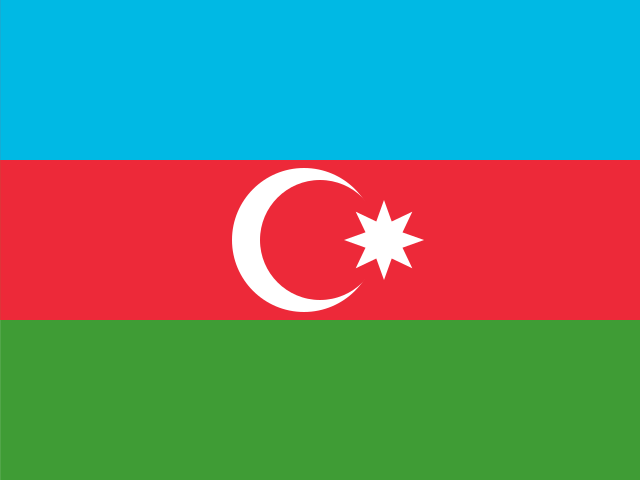 Asia · Western AsiaOutline guide
Country in Eastern Europe and West Asia
Photo: Franzfoto, CC BY-SA 3.0 via Wikimedia Commons
Azerbaijan (Azerbaijani: Azərbaycan) is a former Soviet republic in the Caucasus and is variously considered part of Europe or Asia.
Answers to what travellers most often look up about Azerbaijan.
Azerbaijani, Russian
The official language of Azerbaijan is Azeri or Azerbaijani, spoken by 90-95% of the population.
Make sure your diphtheria, tetanus, and Hepatitis A & B immunizations are up to date. Malaria is a risk in lowland Azerbaijan, particularly around the border with Iran.
Azerbaijanis are a very reserved but very polite and well-mannered people.
Covered in the guide
Attractions, food, stays and travel essentials, with ratings, reviews, opening hours and directions.

Baku (Azeri: Bakı) is the capital of Azerbaijan and is the largest city in the Caucasus. Baku's Old Town has UNESCO World Heritage status.

Ganja (Azeri: Gəncə) is a city in the Ganja Region of northwestern Azerbaijan. As a historic city, Ganja was the seat of the Atabegs, and later, its khanate under Persian suzerainty.
Lankaran, Lenkeran, or Lenkoran (Lənkəran) is in Azerbaijan's Talysh Region.

Nakhchivan is the capital of the Nakhchivan Exclave of Azerbaijan, a.k.a, the Nakhchivan Autonomous Republic.

Qabala (Qəbələ) is a city in Azerbaijan's Sheki Region.

Shaki (azr. Şəki, sometimes spelled "Sheki") is Azerbaijan's true travel gem, a small city off on the forested slopes of the Greater Caucasus Mountains.

Shamakhi (Shemakha, Şamaxı) is a town in Azerbaijan's Baku Region, capital of the Shamakhi Rayon.

Sumqayit, or Sumgayit (Sumqayıt) is the third-largest city in Azerbaijan.

Qobustan is a city in Azerbaijan's Baku Region.

Göygöl National Park (Göygöl Milli Parkı) is in Ganja Region of Azerbaijan.
Sheki Region is a region in Azerbaijan with the Caucasian Mountains on its northern half, which includes the Balakan, Goychay, Ismailli, Oguz, Qabala, Qax, Sheki, and Zaqatala rayons.

Khinalug the highest (2250 m above sea level), most remote and isolated village in Northeastern Azerbaijan and among the highest in the Caucasus.

Nabran is a city in the Northeastern region of Azerbaijan, 45 km north of Khachmaz, close to the Russian border.

Quba (or Guba) is a city in Northeastern Azerbaijan, on the northern slope of the Caucasus, 180 km northwest of Baku.

Lahich (Lahıc, Lahij) is a remote and scenic mountain village of fewer than a thousand people in the Sheki Region. It is famous for traditional copper work.

Qax, Qakh, also Kakhi (კახი) or sometimes Gakh is a town in Azerbaijan's Qakh Region. It is at the foot of the southern slope of the Greater Caucasus, on the river Kurhumchai.

Göygöl is a town just south of Ganja in Ganja Region of Azerbaijan.

in Northeastern Azerbaijan.

well-known petroleum spa resort, the centre of medical tourism in Azerbaijan.

Baku Region is a region in Azerbaijan, which includes the Absheron, Agsu, Baku, Haciqabul, Khyzy, Qobustan, and Shamakhi rayons.
Places in Azerbaijan on the World Heritage List.

Gobustan State Historical and Cultural Reserve
Listed 2007

Gobustan Rock Art

Walled City of Baku with the Shirvanshahs' Palace and Maiden Tower
Listed 2000

Cultural Landscape of Khinalig People and “Köç Yolu” Transhumance Route
Listed 2023

Hyrcanian Forests
Listed 2019

Historic Centre of Sheki with the Khan’s Palace
Listed 2019
List from Wikidata (CC0). Photos from Wikimedia Commons.
The political, economic, and cultural centre of Azerbaijan with capital Baku. Oil has been extracted here since 1871.
Gateway to Azerbaijan with one of the oldest Caucasian cities, Ganja, and the well-known petroleum spa resort and the centre of medical tourism in Azerbaijan, Naftalan.
A beautiful green Caucasian mountain region bordering Georgia, and containing Azerbaijan's loveliest city, Sheki.
An ethnically diverse region in the Greater Caucasus mountains covered with lush green forests, and beautiful beaches and luxury resorts along the Caspian Sea.
An exclave bordering Turkey to the west.
Southern Azerbaijan is a region in Azerbaijan, which includes Agjabadi, Beylaqan, Kurdamir, Imishli, Saatli, Ujar, Zardab rayons as well as the parts of Agdam and Fuzuli rayons under Azerbaijani control.
Talysh Region is a region in southeastern Azerbaijan, which includes the Astara, Bilasuvar, Jalilabad, Lankaran, Lerik, Masalli, Neftchala, Sabirabad, Salyan, and Yardymli rayons.
Mountainous southwest of the country largely occupied between 1994–2020 by the UN-unrecognized Nagorno-Karabakh Republic. Since 2023, all of it is under Azerbaijani control.
Public transport and paid services in Azerbaijan.
By train
With a few exceptions, trains in Azerbaijan are night trains that connect Baku with distant regions of the country.
By taxi
Taxies require some negotiating skills. But using a calculator (smartphone!) to agree on a price works.
By car
Azerbaijan is a country with a high number of road accidents—traffic rules are often not respected. The poor state of the roads and the lack of lighting make it advisable to avoid driving after dark.
By rental car
Due to remote location of many sights and scarcity of attractions in this otherwise huge country, it can be meaningful to rent a car.
Apps for booking a taxi or a ride in Azerbaijan.
Finding apps for Azerbaijan…
Other ways to travel:By thumbOn foot and navigation
Operators checked against their official websites in October 2026; services that have stopped running are not listed. Logos and Wikipedia links: Wikidata (CC0)
Choose an airport to see hotels, stations, taxi ranks and car rental desks around it.
Baku · International · GYD
Loading places around the airport…
Calculated from climate averages: mild daytime highs and lower rainfall. It does not account for festivals, crowds or prices.
Average conditions in Baku
| Jan | Feb | Mar | Apr | May | Jun | Jul | Aug | Sep | Oct | Nov | Dec | |
|---|---|---|---|---|---|---|---|---|---|---|---|---|
| Avg. high | 8° | 7° | 10° | 13° | 20° | 25° | 28° | 29° | 25° | 19° | 14° | 10° |
| Avg. low | 5° | 4° | 6° | 9° | 15° | 21° | 24° | 25° | 21° | 16° | 11° | 7° |
| Rainfall (mm) | 16 | 15 | 16 | 13 | 10 | 6 | 3 | 4 | 13 | 22 | 25 | 17 |
| Humidity | 82% | 82% | 82% | 80% | 77% | 71% | 69% | 67% | 69% | 76% | 80% | 82% |
Choose your passport and destination to see whether you need a visa.
Budget
$40
Per person, per day
Mid-range
$100
Per person, per day
Luxury
$255
Per person, per day
| Budget | Mid-range | Luxury | |
|---|---|---|---|
| Accommodation | $20 | $55 | $150 |
| Food and drink | $10 | $20 | $45 |
| Local transport | $5 | $10 | $20 |
| Activities | $5 | $15 | $40 |
Estimate from World Bank price levels (2025). Actual costs vary by city and season. World Bank
—
We do not label countries as safe or unsafe. Below is the official advice from two governments, with the date it was last updated. Always read the full advice before you travel.
US Department of State
Level 3 of 4Reconsider travel
Reconsider travel to Azerbaijan due to terrorism, armed conflict, and risk of landmines. Some areas have increased risk. Read the entire Travel Advisory. Armed Conflict Following the onset of hostilities between the United States and Iran on February 28, 2026, there has been an ongoing threat of drone and missile attacks from Iran. There was a March 5, 2026, drone strike on Nakhchivan International Airport. Commercial flights have also been seriously disrupted. Terrorism There is risk of terrorist violence, including terrorist attacks and other activity in Azerbaijan. Visit the U.S. Department of State's country reports on terrorism to learn more. Terrorist groups continue to plan attacks and are a risk in Azerbaijan. Terrorists may attack with little or no warning. They may target: Tourist locations Transportation centers (airports) Markets and shopping malls Local government buildings Hotels, clubs and restaurants Places of worship Parks Major sporting and cultural events Educational institutionsOther public areas Other public areas Do not travel to: The southern border region due to risk of armed conflict (unless this is your best overland exit from Iran). The border with Armenia due to risk of landmines. The following territories due to landmines: Aghdam, Aghdara, Fuzuli, Gubadli, Jabrayil, Kalbajar, Khankendi, Khojaly, Khojavend, Lachın, Shusha, and Zangilan
UK Foreign, Commonwealth & Development Office
Advises against all travel to parts of the country
Your travel insurance could be invalidated if you travel against advice from the Foreign, Commonwealth & Development Office (FCDO). Areas where FCDO advises against travel Azerbaijan-Armenia border The border with Armenia remains closed. The FCDO advises against all travel to within 5km of the border with Armenia, due to tensions between Azerbaijan and Armenia. Note that this does not include the border of Azerbaijan’s Nakhchivan exclave with Armenia. Areas where FCDO advises against all but essential travel South-western Azerbaijan (those regions affected by conflict in 2020 and 2023) The Foreign, Commonwealth & Development Office (FCDO) advises against all but essential travel to: The districts (‘rayons’) of Kelbajar, Lachin, Qubadli, Zengilan, Jabrayil, Fuzuli, Khojavand, Shusha, Khojali, Khankendi, Aghdam and Tartar You should follow Azerbaijani national government and local authorities’ advice in areas that have not been cleared of mines or unexploded ordnance. Find out more about why FCDO advises against travel. UK government support Help for British nationals is extremely limited in the areas where we advise against travel. Regional escalation There is a heightened risk of regional tension. Escalation could lead to travel disruption, including airspace closures and other unanticipated impacts. British nationals should take sensible precautions, considering their own individual circumstances. These include: read if you’re affected by a crisis abroad - GOV.UK. This includes guidance on “how to prepare for a crisis” with suggestions on what you might…
Stories, itineraries and practical advice for travelling in Azerbaijan.
 Culture & history
The ancient Persian Empire included areas far beyond modern Persia, now called Iran. At times the Persians controlled much of the Middle East — they were a main antagonist of Ancient Greece a few centuries BCE, and…
Wikivoyage
 Travel tips
Woven carpets are traditionally crafted in North Africa and many parts of Asia, mainly along the Silk Road. They are sometimes called Oriental carpets, and are often associated with Islamic cultures, partly due to their…
Wikivoyage
 Itineraries
The Transcaucasian Trail is a long-distance hiking route under development across Armenia, Georgia, and Azerbaijan, eventually linking the Greater and Lesser Caucasus in two intersecting trails totaling about 3,000 km.
Wikivoyage
 Itineraries
The Janapar Trail, in Nagorno-Karabakh, goes through the beautiful landscape of the Caucasus mountains. The marked trail involves 8-16 days of hiking, starting from the southern end of the trail in Hadrut and ending in…
Wikivoyage
 Food & drink
While the Middle East is vast and diverse, similar culinary traditions can be found across the region. They have been formed by the Mediterranean climate, commercial routes to Europe, Asia and Africa, and the Abrahamic…
Wikivoyage
 Culture & history
Zoroastrianism is an ancient Iranian religion with a history spanning over 3,500 years, that survives to the present day.
Wikivoyage
Every section of the guide. Open one to read it in full.


