//

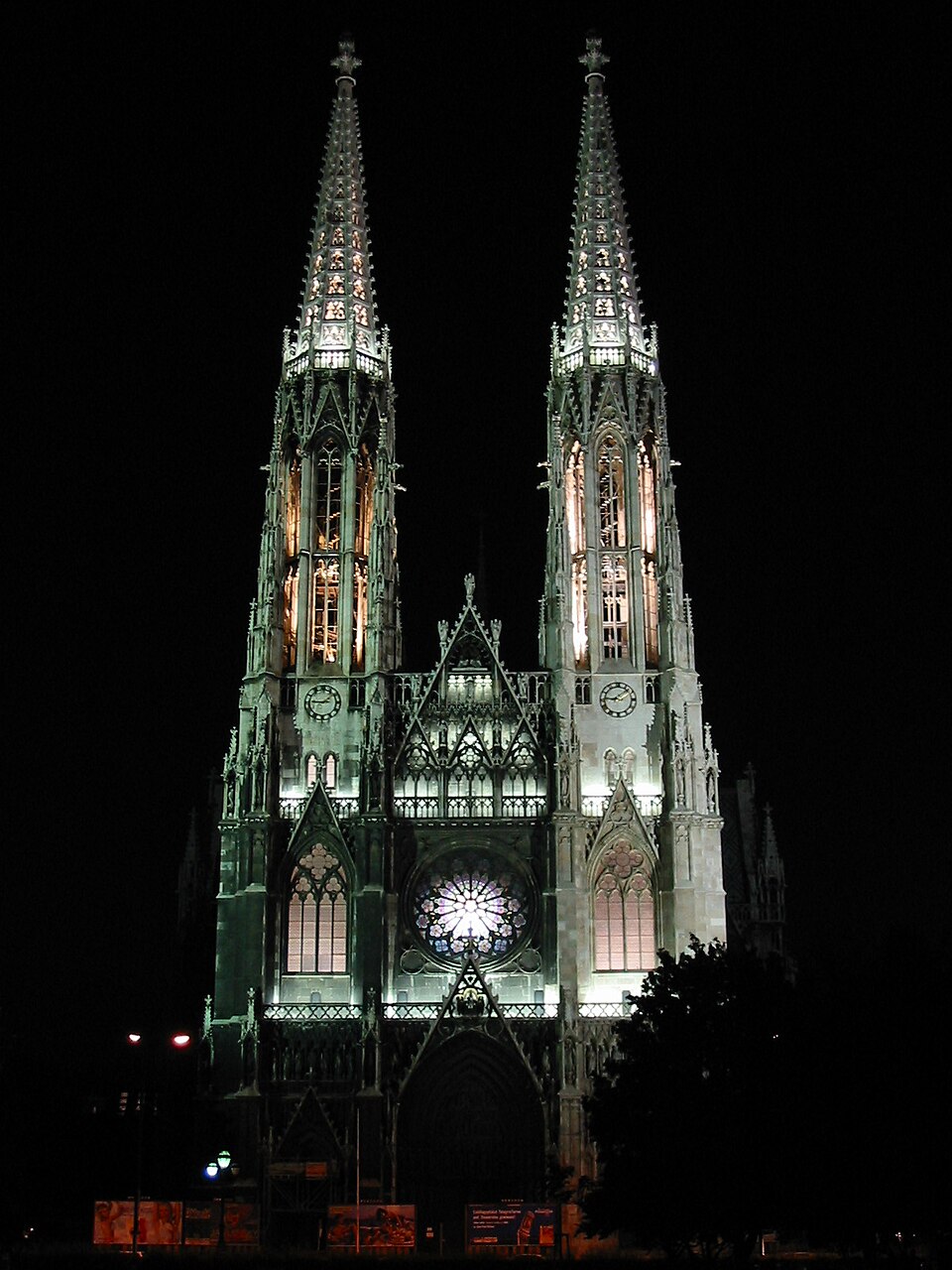
Photo: Stephan Brunker, CC BY-SA 3.0 via Wikimedia Commons
One of the most important Neo-Gothic religious architectural sites in the world, constructed between 1856 and 1879. Stands on a large square on the location where an unsuccessful attempt to assassinate Emperor Franz Joseph took place in 1853. The plans were established by Heinrich von Ferstel (1828-1883), who chose to build the cathedral, borrowing heavily from the architecture of Gothic French cathedrals. It is made of white sandstone, similar to the Stephansdom, which is very vulnerable to air pollution and acid rain and therefore requires frequent renovations.
The Votivkirche is a neo-Gothic style church located on the Ringstraße in Vienna, Austria. Following the attempted assassination of Emperor Franz Joseph in 1853, the Emperor's brother Archduke Ferdinand Maximilian inaugurated a campaign to create a church to thank God for saving the Emperor's life. Funds for construction were solicited from throughout the Empire. The church was dedicated in 1879 on the silver anniversary of Emperor Franz Joseph and his wife Empress Elisabeth.
© OpenStreetMap contributors
The cinema screens international movies including many French ones. The annual Vienna Film Festival is hosted here. On Sunday morning there is a film breakfast. The cinema opened in 1912.
This small museum is in Freud's historic flat where he practiced psychoanalysis for almost his whole life. However, the collection is limited mostly to documents of various kinds relating to Freud's life. Almost all of the flat's contents, including the famous original couch, went along with Freud to London when he fled the Nazis in 1939 and are now in the Freud Museum there.
Founded by Emperor Joseph II as the Academy of Medico-Surgery, the building was completed in 1785 and houses nearly 1200 anatomical wax models commissioned by the emperor, along with medical documents and instruments. The Josephinum is still used for research today.
A small theatre.
Pathological and Anatomical State Museum
Housed in a squat tower, which once was an insane asylum, the Narrenturm (Fool's Tower), this museum contains some of the dustier corners of the annals of medicine. You will find preserved hydrocephalic infants, wax castings of tertiary syphilis, antique medical devices, and even a laryngeal tuberculous ulcer. The gift shop sells postcards depicting the best of these.
Designed by Theodor Johann Jaeger and completed in 1910, the outdoor staircase connects Strudlhofgasse and Liechtensteinstraße, and is a significant example of Jugendstil architecture.