//

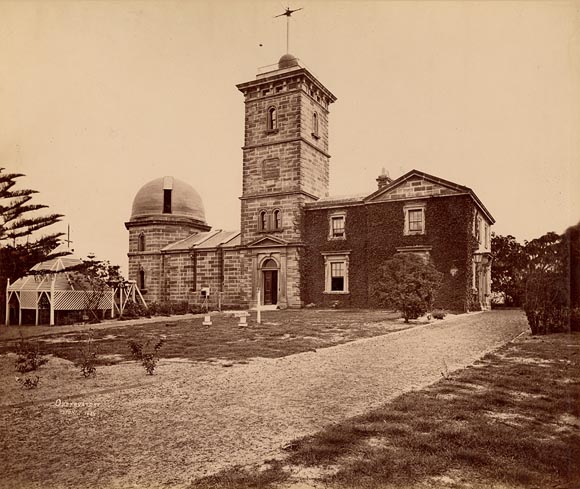
Photo: New South Wales Government Printing Office, Public domain via Wikimedia Commons
Australia's oldest observatory. It has a variety of exhibitions, a “beanbag planetarium” and of course, telescopes. The parks and views of the harbour from the Observatory Hill are exceptional. It's worth a visit even if you have no interest in astronomy and are not even going into the building. You can book a night tour guided by an astronomer, where you're allowed to use the telescope and see what is visible during night time. The old telescopes here aren't the most powerful around; the portable telescopes set up are just as powerful as the large ones in the domes. It makes for a fun, informative night out. Children are catered for in both the daytime and evening sessions.
The Sydney Observatory is a heritage-listed meteorological station, astronomical observatory, function venue, science museum, and education facility located on Observatory Hill at Upper Fort Street, in the inner city Sydney suburb of Millers Point in the City of Sydney local government area of New South Wales, Australia. It was designed by William Weaver (plans) and Alexander Dawson (supervision) and built from 1857 to 1859 by Charles Bingemann & Ebenezer Dewar. It is also known as The Sydney Observatory; Observatory; Fort Phillip; Windmill Hill; and Flagstaff Hill. It was added to the New South Wales State Heritage Register on 22 December 2000.
© OpenStreetMap contributors
The colony's first military church, it is still an active Anglican church.
The headquarters of National Trust NSW, it was once a military hospital and state school. The SH Erwin Gallery is located within and hosts exhibitions every now and then.
Follow Argyle St through this historic sandstone road cutting made between 1843 and 1867, made with the effort of both convict and paid labour. The sights and sounds of the convict labour, still bound in chains and working only with crude tools, horrified the locals and the cutting was abandoned after just three years. A long interlude lasted before the city council eventually linked Millers Point and The Rocks together with the use of paid labour and explosives.
Owned by Sydney Living Museums. Built in 1844, Susannah Place Museum preserves a row of four terrace houses that incorporate a re-created 1915 corner store, providing a rare opportunity to construct patterns of domestic working class life from the mid 1840s to the late 20th century. It is evidence of the rich community that once existed in The Rocks. The modest interiors and rear yards illustrate the restrictions of 19th century inner city life.
You can climb to the top of the arch of the bridge. For those who are good with heights and enjoy a spectacular view of the harbour, there are organised climbs to the top of the bridge. This climb is more demanding than climbing a set of stairs, although it is not so demanding as the name implies. You will be fitted with special climbing suits and secured by safety tethers, you must be 10 years old or over to take the climb. The climb takes 3½ hours and a group leaves every 10 minutes. You can ascend during the day, at twilight and at night. Book your climb as early as possible as the climb is very popular. Loose items including cameras are prohibited on the climb; Bridge Climb staff will take a photo of you, but you may not take photographs yourself.
Art museum focusing on work by contemporary Australian artists. Housed in a fabulous 1930s art deco building, former location of the Maritime Services Board and facing onto the western side of Circular Quay and Sydney Cove, the MCA has been dedicated since its opening in 1991 to showcasing great works of modern and contemporary art in all media. One wing is newer, contemporary architecture; the other is a historic building used for port administration until the 1930s. The museum runs some arts education programs for children and disabled people.