//

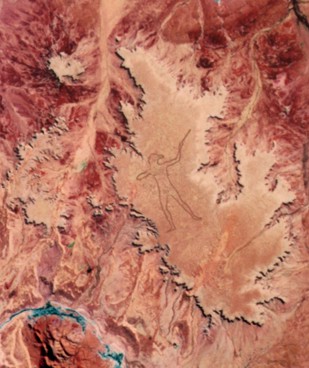
Photo: Lauren Dauphin, Public domain via Wikimedia Commons
While not actually in the town, this geoglyph put the town on the map for some time. Discovered by Europeans in 1998, this 4.2km tall man was etched into the desert sand presumably only a few years prior. It's creator remains a mystery, but clues later pointed to it being funded by Americans. Some view it as a landmark to the Aboriginal culture and the outback, while others call it 'environmental vandalism'. Either way, it is a sight worth seeing if you can afford the charter plane that will take you to see it.
The Marree Man is a modern geoglyph discovered in 1998 in Outback South Australia. It depicts an Aboriginal man hunting with a boomerang or stick. It lies on a plateau at Finniss Springs, 60 km (37 mi) west of the township of Marree in central South Australia, approximately 12 km north-west of Callanna. It is just outside the 127,000-square-kilometre (49,000 sq mi) Woomera Prohibited Area. The figure is 2.7 km (1.7 mi) tall with a perimeter of 28 km (17 mi), extending over an area of about 2.5 km2. Discovered fortuitously by a charter pilot in an overflight on 26 June 1998, it is one of the largest geoglyphs in the world, arguably second to the Sajama Lines). Its origin remains a mystery: no one claimed responsibility for its creation and no eye-witness has been found, notwithstanding the scale of the operation required to form the outline on the plateau floor. The description "Stuart's Giant" was used in anonymous faxes sent to media as press releases in July 1998, in a reference to the explorer John McDouall Stuart.
© OpenStreetMap contributors